

Reviewed · SAN DIEGO MUSEUM TICKETS
USS Midway Museum Admission: Valid Any Date
The USS Midway is not a building filled with naval artifacts. It is the artifact. You walk through the actual carrier, from the four-acre flight deck down into cramped sleeping quarters, galleys, officer’s country, and the engine room. The ship served from 1945 to 1992 and once carried more than 4,500 people.
I like the freedom to arrive any time during the 10 a.m. to 5 p.m. opening period, and I like the human touch provided by the yellow-hat volunteers, many of them former sailors who served aboard the Midway. The main drawback is simple: this is a huge ship with plenty of stairs, so two hours can feel rushed and five hours can pass quickly.
I also like the included audio tour, which uses the voices and stories of former officers and sailors instead of giving you a dry list of dates. Just remember that prebooked admission lets you bypass the ticketing line, not every line inside the museum, and summer parking near the ship can be tight.
Key points to know before boarding
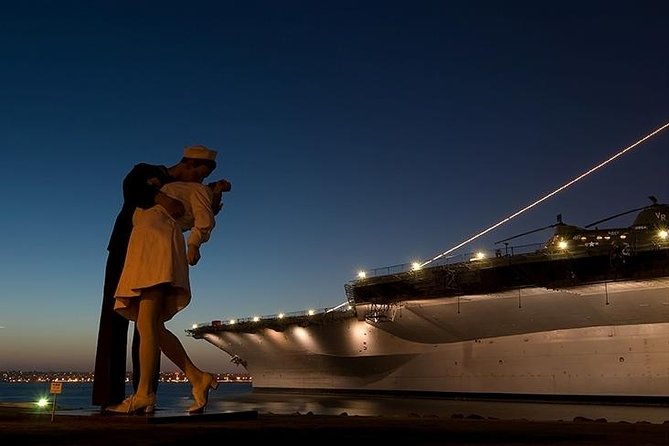
- A real aircraft carrier, not a replica: Walk through a ship that served in the US Navy from 1945 to 1992.
- Former sailors add the personal stories: Yellow-hat volunteers explain flight-deck work, navigation, shipboard routines, and daily life.
- Plan for three to five hours: You can see the highlights in two hours, but the ship rewards a slower visit.
- The flight deck is the main event: Restored aircraft, wide ocean views, and downtown San Diego create the strongest part of the visit.
- The audio tour comes with admission: Use it to connect rooms and machinery with the people who worked there.
- Wear practical shoes: You will walk through a large ship and climb stairs, although elevator access is available on several routes.
A carrier that feels like a city at sea

The first thing you notice is scale. The USS Midway was once the largest ship in the world for about a decade, and it was too large to pass through the Panama Canal. That fact makes more sense after you board and see how many decks, corridors, work areas, and living spaces fit inside one vessel.
More than 225,000 sailors served aboard the Midway over its active life. The museum gives you a physical sense of that number. You are not simply looking at a uniform behind glass. You are walking through the spaces where people slept, ate, worked, waited, repaired equipment, and prepared aircraft.
The ship’s location on San Diego’s Embarcadero makes it easy to add to a day downtown. It also gives you a strong view of the waterfront from the flight deck. The museum is a major attraction, but it does not feel detached from the city around it. You can see San Diego spread out beyond the ship while standing in the place where naval crews once handled aircraft and demanding daily routines.
More museum tickets in San Diego:
- Maritime Museum of San Diego Admission Ticket
★ 4.5 · 98 reviews - San Diego: San Diego Natural History Museum Ticket
★ 4.7 · 33 reviews - San Diego: Museum of Illusions Entry Ticket
★ 3.5 · 24 reviews
Start on the hangar deck
After entering, you can use the narrated video tour shown continuously on the hangar deck to get your bearings. This is a useful first stop because the carrier can feel confusing at ground level. A few minutes here helps you understand how the decks connect and what kind of working environment you are about to explore.
The hangar deck also introduces the museum’s central idea: the Midway was a functioning community as much as it was a warship. Aircraft needed storage and repair. Food had to be prepared for thousands of people. Engines, communications, navigation, medical care, sleeping arrangements, and command operations all had to work together.
From here, you can follow the self-guided audio tour and visit the highlighted locations marked throughout the ship. The route includes up to 65 points of interest, so you do not need to guess which doors and corridors matter most.
I recommend listening selectively rather than trying to absorb every word. If you play the entire audio program without pauses, you may spend less time looking closely at the spaces around you. Stop the narration when a volunteer is explaining something nearby, then resume it later.
See how sailors lived below deck
The restored living areas are among the most effective parts of the museum. The galleys show the practical side of feeding a ship’s population. Sleeping quarters make clear how little personal space many sailors had. Officer’s country gives you a different view of the ship’s internal structure and the separation between ranks.
These areas matter because the flight deck can make naval life look dramatic and glamorous. Below deck, the experience becomes more ordinary and more demanding. People still had to sleep, eat, dress, maintain equipment, and find their way through a complicated vessel while the ship operated at sea.
You may find the corridors tight and the route less comfortable than a typical museum. That is part of the point, but it is also a practical concern. If you dislike confined spaces or have trouble with stairs, plan your route carefully and use the available elevators where possible.
Elevator access is provided from Navy Pier onto the ship, from the hangar deck down to the second deck, and up to the flight deck. The museum is described as accessible for people with disabilities, but not every part of an old carrier will feel equally easy to reach. Ask staff for the best route if you need to avoid stairs.
Let the yellow-hat volunteers fill in the gaps
The yellow-hat volunteers are one of the best reasons to avoid rushing through the Midway. These retired military volunteers are stationed around the ship and share information about the carrier, aircraft operations, navigation, and shipboard work.
Their value is not just in explaining facts. They can help you picture how a place was used. A technical room becomes easier to understand when someone explains what sailors watched, repaired, carried, or listened for there.
You will hear stories from people who served on the Midway, though the specific volunteer available on your visit will vary. Some visitors spend much of their time speaking with these guides, and that can add an hour or more to the visit. If you have five hours available, this is the best use of the extra time.
The volunteers also make the museum feel less formal. You can ask a direct question, point to an unfamiliar piece of equipment, or request help understanding the order of operations on the flight deck. I would not treat the audio tour and the yellow hats as competing options. Use the audio tour for structure, then use the volunteers for detail and personal stories.
More museums in San Diego:
- San Diego: Maritime Museum of San Diego Admission
★ 4.6 · 17 reviews - San Diego Natural History Museum Nighttime Entry Ticket
★ 5.0 · 5 reviews - San Salvador 16th Century Galleon Sail w/ Museum Admission
★ 5.0 · 3 reviews - San Diego: Californian Tall Ship Sailing and Maritime Museum
★ 5.0 · 3 reviews
Take your time on the four-acre flight deck
The flight deck is the ship’s showpiece. It covers four acres, so it gives you room to walk, stop, look at aircraft, and take in the views without feeling boxed in. It is also where the Midway’s purpose becomes most obvious.
Twenty-five restored aircraft are displayed across the ship. The collection gives you a chance to compare different aircraft forms and understand how much room was needed to move, park, service, and launch them. Several aircraft are arranged for a closer look, and interactive displays help make the exhibits suitable for children as well as adults.
The deck is also one of the best photo locations in the museum. You can look toward downtown San Diego, the waterfront, and the surrounding harbor area. The panoramic view gives you a useful sense of the carrier’s position in the city, while the aircraft provide the visual focus.
Wind and sun can make the flight deck feel different from the enclosed parts of the ship. Bring water, especially if you plan to stay several hours. Comfortable walking shoes are important, but choose shoes that also feel secure on stairs and hard surfaces.
Explore the bridge and engine room

The route reaches well beyond the aircraft displays. The bridge shows where the carrier was directed and managed. Even if you do not have a naval background, the space helps explain how a ship of this size could be controlled by a relatively small group of people in a demanding setting.
The engine room offers the opposite perspective. Instead of looking outward over aircraft and water, you are dealing with the hidden systems that made movement possible. This is a good place to slow down and think about the amount of labor required to keep a ship operating.
The museum’s 65 highlighted locations connect these major areas with smaller spaces along the way. You may find navigation displays, work areas, equipment, and signs that answer basic questions before you need to ask them. The route is educational, but it does not require a military background.
Try the interactive exhibits and flight simulators

The Midway is not only a walk through preserved rooms. Interactive exhibits give children and adults something to do with the information. Aircraft displays can be approached as objects of engineering, while the ship’s operational areas show how many jobs were needed to keep everything working.
The flight simulators are a popular finishing point, especially for families. They add a more active element after several hours of reading and walking. Extra activities may take time, so do not build your schedule around seeing the whole museum in a quick burst.
Some parts of the ship are visually impressive right away. Others need patience. The best visit mixes both: spend time on the flight deck and with the aircraft, then follow the audio tour into the less obvious rooms where daily life and ship operations become clearer.
How much time should you allow?

The stated visit range is two to five hours, and both ends are realistic. Two hours lets you see the flight deck, several aircraft, selected exhibits, and some living areas. It is enough for a worthwhile stop, but you will need to make choices.
Three to four hours gives you a better balance. You can follow much of the audio tour, speak with volunteers, visit the major decks, and pause for photos. This is the amount of time I would plan for on a normal San Diego sightseeing day.
Five hours suits anyone who wants to listen carefully, ask questions, and explore without checking the clock. A café is available aboard the ship, and you can take a break before continuing. Bring a snack and water bottle if you prefer to keep moving, since the museum is large and the walking adds up.
The museum is open daily from 10 a.m. to 5 p.m., with last admission at 4 p.m. Arriving early is especially sensible in summer, when nearby parking is limited. Since your ticket is valid for any date, you have useful flexibility, but you still need to visit during those operating hours.
Is the $41 admission a good value?
At $41 per person, this is not a bargain attraction in the narrow sense. You are paying more than you would for a small city museum, but the ticket covers access to an enormous historic ship, the audio tour, interactive exhibits, aircraft displays, and the volunteer program.
The value improves if you plan to stay at least three hours. A two-hour visit can still work, but the cost feels harder to justify if you only rush across the flight deck and leave. The Embarcadero Adventure offers, which include discounts for other nearby attractions, may also help if you plan to see more around the waterfront.
There are a few possible extra costs. Parking is not included and is available nearby through Ace Parking for an additional fee. Food, drinks, flight simulator charges if applicable, and gift-shop purchases should be treated as separate spending.
For families, the ticket can work well because the ship offers several kinds of activity: aircraft, machines, stories, views, confined corridors, and hands-on features. For someone mainly interested in naval history, it offers enough depth to justify a longer visit. For a visitor with only a short gap between other plans, it may be better to choose a few sections rather than pretend you can see everything.
Who will enjoy the Midway most?
I would recommend this experience to anyone interested in military history, aviation, engineering, or the practical details of life at sea. It also works for families because the ship gives children something concrete to explore rather than asking them to read labels in a quiet gallery.
You do not need previous naval knowledge. The audio tour, signs, narrated video, and volunteers explain the basics. The most curious visitors will get the most from it, especially if they ask questions and take time in the working areas.
It is less suitable if you want a short, effortless attraction. The carrier is large, the route includes stairs, and the amount of information can feel heavy if you try to cover every point. Wheelchair access is available on important routes, but the ship’s historic design means some areas may still require planning.
The 4.9 rating from more than 2,000 submitted ratings and the 98 percent recommendation figure fit my own assessment of the attraction’s appeal: the ship itself is exceptional, and the former sailors give it a personal layer that a standard museum cannot easily copy.
Booking, arrival, and cancellation details
Your mobile ticket lets you proceed to the front gate rather than stopping at the ticketing counter. It does not remove lines for exhibits or activities inside the attraction. Confirmation is provided at booking, and the activity is offered in English.
Public transportation is nearby, and parking is available adjacent to the Midway for an added fee. Hotel pickup and drop-off are not included, so you will need to make your own way to the Embarcadero.
Free cancellation is available if you cancel at least 24 hours before the experience’s start time. Cancellations within 24 hours are not refunded, and changes in that same period are not accepted. Service animals are allowed.
Should you book the USS Midway?
Yes, if you can give it at least three hours and you want more than a quick photo beside a famous ship. The strongest parts are the flight deck, restored aircraft, former sailor volunteers, and below-deck spaces that show how a large crew actually lived and worked.
Book it with comfortable shoes, a flexible schedule, and realistic expectations about stairs and walking. If you have only two hours, focus on the hangar deck, flight deck, aircraft, and a few volunteer talks. If you have five hours, follow the audio tour slowly and let the yellow hats turn the carrier from an impressive object into a place full of human stories.
FAQ
How long does a visit to the USS Midway Museum take?
The visit usually takes about two to five hours. Two hours covers major highlights, while three to five hours allows more time for the audio tour, volunteers, living areas, aircraft, and interactive exhibits.
What are the USS Midway Museum opening hours?
The museum is open daily from 10 a.m. to 5 p.m. The last admission is at 4 p.m.
Does admission include an audio tour?
Yes. Admission includes a self-guided audio tour narrated through stories from former Midway sailors and officers.
Can I skip the ticket line?
Your prebooked mobile admission allows you to go directly to the front gate. It does not apply to lines for exhibits or activities inside the museum.
Is parking included?
No. Parking is not included. Parking is available beside the Midway through Ace Parking for an additional fee, and summer parking can be limited.
Is the USS Midway Museum accessible by elevator?
Elevator access is available from Navy Pier onto the ship, from the hangar deck down to the second deck, and up to the flight deck. The museum is described as accessible for people with disabilities.
Are service animals allowed?
Yes. Service animals are allowed.
Can I cancel for a refund?
Yes, if you cancel at least 24 hours before the experience’s start time. Cancellations made within 24 hours are not refundable, and changes made within that period are not accepted.
Just added around San Diego
- An Art Walk Through the Barrio★ 5.0 · 11 reviews
- All-Inclusive Private Wine Tour in Baja★ 5.0 · 3 reviews
- All Day San Diego Scenic Tour★ 3.0 · 5 reviews
- 4 Hour Private Sail for up to 6 people★ 5.0 · 12 reviews
- Private Vacation Photography Session with Local Photographer in San Diego★ 5.0 · 4 reviews
- Two Hour Kayak and Snorkel Tour for Two in La Jolla★ 4.5 · 34 reviews
- Ultimate La Jolla Self-Guided Driving & Walking Audio Tour Bundle★ 3.5 · 9 reviews
- 2Hr GPS Self Guided Scooter Tour: Downtown & Balboa Park★ 4.0 · 6 reviews
San Diego Museum Tickets, compared.



San Diego Natural History Museum Nighttime Entry Ticket
Read our review →
Californian Tall Ship Sailing and Maritime Museum
Read our review →
San Salvador 16th Century Galleon Sail w/ Museum Admission
Read our review →Browse the lists this tour appears in